License Plate Recognition (ALPR)
A system that automatically detects and reads license plates from photos - a custom fine-tuned detection model paired with OCR, built to strict software engineering practices.
The story behind the project
Reading license plates from ordinary photos is harder than it looks - plates show up at different angles, distances and lighting, and off-the-shelf OCR systems notoriously confuse similar-looking characters (0/O, 1/I, 8/B, 2/Z).
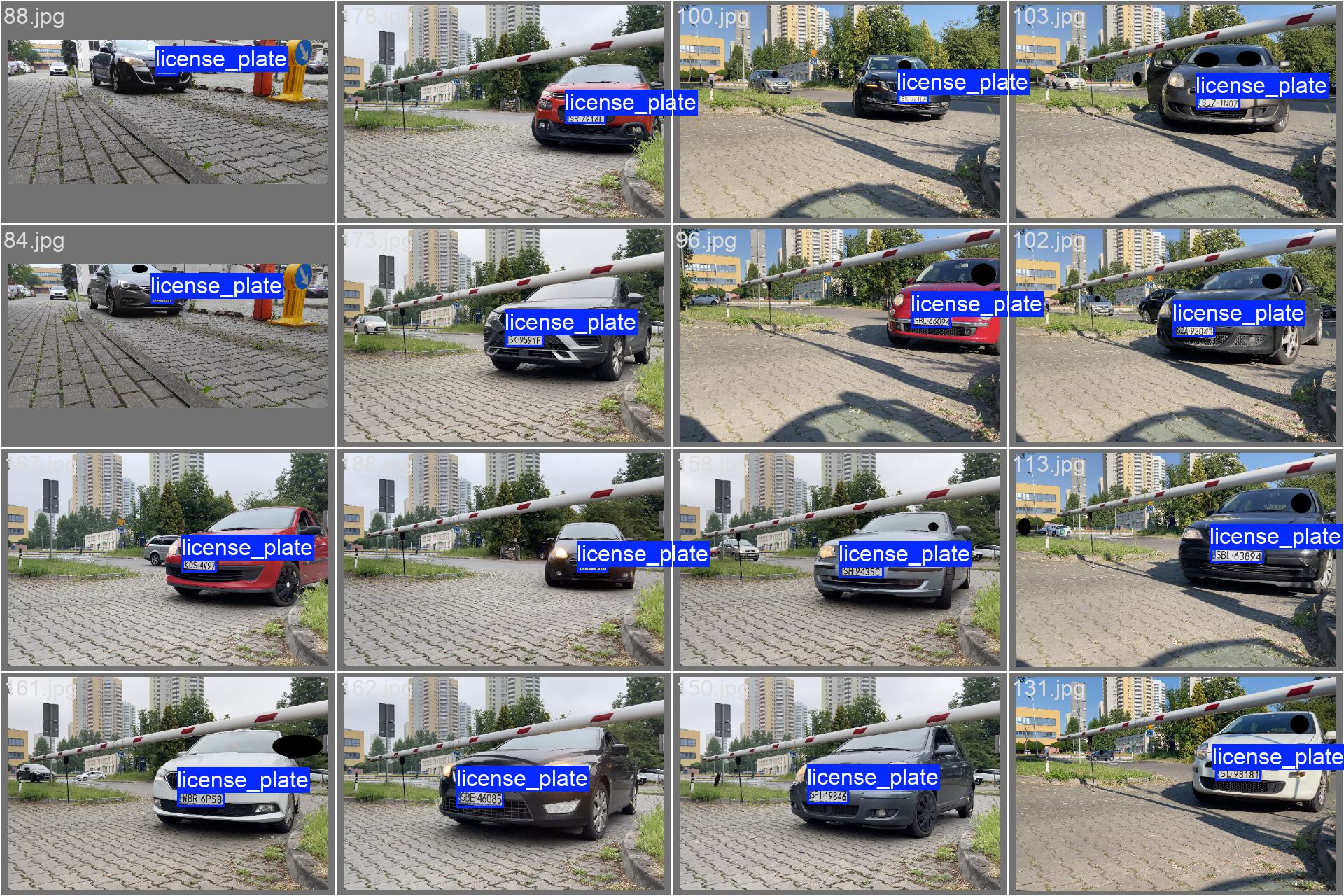
I fine-tuned YOLOv8n (starting from COCO-pretrained weights) on the Poland Vehicle License Plate Dataset (Kaggle, by piotrstefaskiue - kaggle.com/datasets/piotrstefaskiue/poland-vehicle-license-plate-dataset) for 30 epochs at 640px to localize plates, then exported the model to ONNX for fast CPU inference. The cropped plate region is read with EasyOCR, and a normalization layer corrects characters OCR commonly confuses (0/O, 1/I, 8/B, 2/Z) before comparing results. A dedicated metrics module measures IoU and OCR accuracy on a 100-image test set.
The model reached roughly 88% accuracy on the test set, measured by the custom metrics module combining detection IoU with OCR character accuracy across 100 test images.
How it was designed
Fine-Tuning YOLOv8n for Plate Detection
Started from COCO-pretrained weights and fine-tuned YOLOv8n on the Poland Vehicle License Plate Dataset (Kaggle, by piotrstefaskiue) for 30 epochs at 640px resolution to localize plates directly in the image.
- YOLOv8n fine-tuned from COCO weights
- 30 epochs at 640×640 resolution
- Trained on the Poland Vehicle License Plate Dataset (Kaggle)
ONNX Export for Fast CPU Inference
Exported the trained detector to ONNX format so it runs efficiently without a GPU, keeping inference fast on standard hardware.
- Model exported to ONNX
- Optimized for CPU-only inference
- No GPU dependency at runtime
Text Extraction with EasyOCR
Cropped the detected plate region and passed it through EasyOCR to read the characters, isolating text extraction from the detection step.
- EasyOCR reads the cropped plate region
- Decoupled from the detection pipeline
- Works across varied plate fonts and layouts
Character Normalization Layer
Added a normalization step that corrects characters OCR commonly confuses before comparing results, addressing the 0/O, 1/I, 8/B and 2/Z mix-ups that plague raw OCR output.
- Rule-based correction for commonly confused characters
- Applied before result comparison
- Targets 0/O, 1/I, 8/B, 2/Z confusions
Metrics Module for Evaluation
Built a dedicated metrics module that computes IoU for detection accuracy and OCR accuracy against ground truth, run across a 100-image test set to validate the full pipeline.
- Computes IoU for plate localization accuracy
- Computes OCR character/string accuracy
- Evaluated on a 100-image test set